Topic 3. Development of language skills: oral comprehension and expression, written comprehension and expression. Communicative competence in English.
INDEX
- Introduction
- Language skills and communicative competence
2.1. Receptive and productive skills
2.2. The integrated nature of language skills - Oral comprehension
3.1. Listening as an active process
3.2. Strategies for developing listening skills - Oral expression
4.1. From controlled to spontaneous production
4.2. Strategies for developing speaking skills - Written comprehension
5.1. Reading as a meaning-making process
5.2. Strategies for developing reading skills - Written expression
6.1. Writing as a process
6.2. Strategies for developing writing skills - Communicative competence in English
7.1. The concept of communicative competence
7.2. Components of communicative competence
7.3. Communicative competence in Primary Education - Didactic application in the English classroom
8.1. Integrating the four language skills
8.2. Meaningful communicative tasks
8.3. Assessment and attention to diversity - Conclusion
- Bibliographical references and legislation
1. Introduction
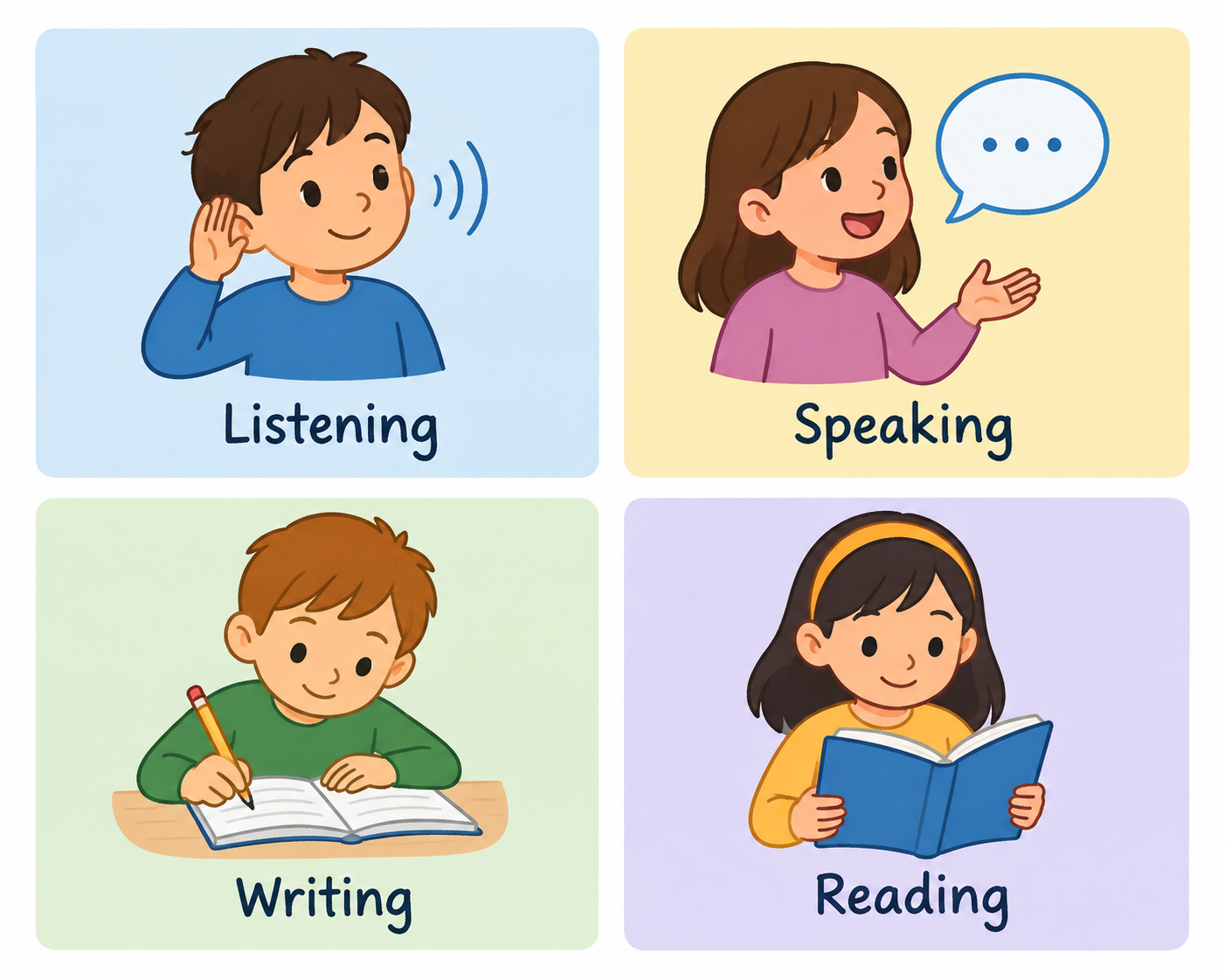
“We acquire language in only one way: when we understand messages.” This idea, associated with Stephen Krashen (1985), highlights one of the essential principles of language learning: pupils need opportunities to receive and produce meaningful language in order to develop their communicative ability.
Learning English at Primary school therefore involves much more than memorising vocabulary or grammatical structures. Pupils need to understand what others say, express themselves orally, read different types of texts and gradually learn to communicate through writing. These four language skills are traditionally divided into oral comprehension, oral expression, written comprehension and written expression.
However, communication does not take place through isolated skills. In everyday situations, people usually combine several of them. For example, when following a recipe, we may read instructions, discuss them with another person and then write a shopping list. Similarly, a classroom project may require pupils to listen to information, discuss it, read additional material and produce a written or oral final product.
For this reason, the development of language skills should be understood as an integrated process aimed at achieving communicative competence. This perspective is fully consistent with the current curriculum for Primary Education, which establishes the acquisition of basic communicative competence in at least one foreign language and gives particular importance to comprehension, expression and oral interaction.
Consequently, this topic will analyse the development of the four language skills and their relationship with communicative competence, paying particular attention to their practical application in the Primary English classroom.
2. Language skills and communicative competence
2.1. Receptive and productive skills
Language skills are traditionally classified into two main groups.
On the one hand, receptive skills are listening and reading. They involve receiving and interpreting messages.
On the other hand, productive skills are speaking and writing. They involve constructing and communicating messages.
This distinction is useful from a didactic point of view, but it should not lead us to consider the four skills as independent areas. Receptive skills provide learners with language input, while productive skills allow them to use and transform that input for communicative purposes.
Furthermore, communication also involves interaction. In a conversation, for instance, pupils alternate between receiving and producing language continuously.
The learner is therefore not simply a passive receiver of information but an active participant who constructs meaning.
2.2. The integrated nature of language skills
The four skills develop progressively and influence each other.
Listening provides models of pronunciation, vocabulary, grammar and discourse. Reading also provides linguistic input and exposes pupils to different text types. Speaking gives learners opportunities to use this language interactively, while writing allows them to organise and communicate ideas in a more permanent form.
For example, a classroom project about animals could begin with a short video. Pupils would listen for specific information, discuss what they have understood, read a short text about an endangered species and finally prepare a short written or oral presentation.
In this type of sequence, the four skills are not taught separately. They are mobilised because the communicative task requires them.
This integrated approach is particularly appropriate in Primary Education because language learning should be meaningful, contextualised and connected with pupils’ experiences.
3. Oral comprehension
3.1. Listening as an active process
Listening is much more than simply hearing sounds. It involves identifying sounds, recognising words, interpreting grammatical and prosodic information, activating previous knowledge and constructing meaning.
In a foreign language, listening can be challenging because pupils have to process unfamiliar sounds and vocabulary, often in real time. Therefore, listening activities should not normally consist of playing an audio recording and asking pupils to answer a series of questions without preparation.
Listening should be understood as an active process in which learners use different clues to construct meaning.
These clues may include:
- Intonation, stress and rhythm.
- Key words.
- Context.
- Images.
- Gestures and facial expressions.
- Previously acquired knowledge.
- The speaker’s tone and attitude.
- Visual information accompanying the message.
Current Primary curriculum guidance also emphasises strategies such as using non-verbal language, images, repetition and the transfer of knowledge from the learner’s existing linguistic repertoire to facilitate comprehension.
3.2. Strategies for developing listening skills
Listening activities can be organised into three stages.
Before listening, the teacher activates previous knowledge and creates expectations. Pictures, key words, questions or predictions can prepare pupils for the content.
During listening, pupils should have a clear and realistic purpose. They may identify the main idea, select an image, complete a chart, order pictures or find specific information.
After listening, learners can check their answers, discuss the information or use it as a starting point for another task.
For example, before watching a short video about London’s landmarks, the teacher can show several pictures and ask pupils to predict what they will hear. During the video, pupils identify three landmarks. Afterwards, they compare their answers and choose one landmark to research.
It is also advisable to expose pupils to different voices, accents and formats progressively, always taking their age and level into account.
The objective is not for pupils to understand every single word, but to develop strategies that allow them to understand the message as a whole and obtain relevant information.


4. Oral expression
4.1. From controlled to spontaneous production
Speaking is one of the most visible manifestations of language learning, but oral production does not develop simply by asking pupils to “speak English”. Learners need a progression from controlled and highly supported activities towards more spontaneous communication.
At the beginning, pupils may repeat words, complete sentence frames or respond to predictable questions. Later, they can participate in pair work, role plays, information-gap activities and short presentations.
For example, the progression could be:
“What’s your favourite animal?”
“My favourite animal is…”
“What does it look like?”
“It is big and…”
Finally, pupils could use this language to carry out a real communicative task, such as interviewing a partner and presenting their answers to the class.
This progression provides security while gradually increasing communicative autonomy.
4.2. Strategies for developing speaking skills
A communicative classroom should provide frequent opportunities for pupils to speak.
Useful activities include:
- Pair and group discussions.
- Information-gap activities.
- Role plays.
- Interviews.
- Picture descriptions.
- Storytelling.
- Songs and chants.
- Games.
- Short presentations.
- Classroom routines.
- Problem-solving tasks.
The teacher also needs to create a supportive environment in which mistakes are considered a natural part of learning.
Fluency should not always be interrupted to correct every error. During communicative activities, the priority may be maintaining interaction, while more specific accuracy work can take place at another moment.
Non-verbal resources and communication strategies are also important. Pupils can use gestures, repetition, simpler words or requests for clarification when they do not know how to express something.
In this way, speaking becomes an opportunity not only to demonstrate what pupils already know, but also to develop new communicative resources.
5. Written comprehension
5.1. Reading as a meaning-making process
Reading involves much more than decoding individual words. A reader constructs meaning by combining textual information with previous knowledge, expectations and contextual clues.
This is particularly important in English because the relationship between spelling and pronunciation is not always transparent.
Primary learners should therefore be exposed progressively to different types of written texts: stories, comics, posters, menus, instructions, emails, short descriptions, websites and other age-appropriate texts.
The purpose of reading should also be varied. Pupils may read to obtain information, follow instructions, enjoy a story, solve a problem or complete a task.
5.2. Strategies for developing reading skills
As with listening, reading activities can be organised into three stages.
Before reading, pupils can predict the content from the title, pictures or key words.
During reading, they can identify the main idea, find specific information, match information, sequence events or infer the meaning of an unfamiliar word from context.
After reading, they can summarise the text, express an opinion, complete a creative task or use the information in another communicative situation.
For example, pupils may read a short text about an unusual animal. First, they predict information from a photograph. Then they identify where the animal lives and what it eats. Finally, they create a short fact file and present it to their classmates.
In this way, reading is connected to other skills rather than becoming an isolated comprehension exercise.
6. Written expression
6.1. Writing as a process
Writing in a foreign language requires learners to coordinate vocabulary, grammar, spelling, organisation and communicative purpose.
For this reason, writing should be understood as a process rather than simply as the final product.
A useful sequence includes:
- Planning.
- Drafting.
- Revising.
- Editing.
- Sharing or publishing.
At Primary level, this process should be appropriately guided. Pupils may initially use models, word banks, sentence starters or visual organisers.
For example, before writing a description of a favourite animal, pupils can identify the information they need: name, appearance, habitat, food and interesting facts. They can then organise their ideas and use a model text before producing their own version.
Gradually, the amount of support can be reduced.
6.2. Strategies for developing writing skills
Written production should always have a communicative purpose.
Instead of writing isolated sentences simply to practise a grammatical structure, pupils can write:
- A postcard.
- An email.
- A short story.
- A description.
- A poster.
- A set of instructions.
- A diary entry.
- A short report.
- A comic.
- A digital presentation.
The task should also have a real or simulated audience. Writing for classmates, another class or a partner school gives pupils a reason to communicate.
Technology can expand these possibilities through digital books, collaborative documents, presentations or multimedia projects. However, digital tools should support the communicative objective rather than replace the learning process.
7. Communicative competence in English
7.1. The concept of communicative competence
The development of the four skills ultimately aims at communicative competence.
The concept was introduced into language education particularly through Hymes (1972), who argued that knowing a language involves knowing not only whether a sentence is grammatically correct, but also whether it is appropriate in a particular social situation.
Canale and Swain (1980) subsequently developed a model of communicative competence that included grammatical, sociolinguistic and strategic dimensions. Canale (1983) later distinguished four components: grammatical, sociolinguistic, discourse and strategic competence.
This represents an important change in language teaching. The objective is not simply to produce grammatically correct sentences but to use language effectively and appropriately.
7.2. Components of communicative competence
- Communicative competence can therefore be understood through several complementary dimensions.
- Grammatical competence involves knowledge of vocabulary, grammar, pronunciation and spelling.
- Sociolinguistic competence concerns the appropriate use of language according to the situation, participants and social conventions.
- Discourse competence involves connecting ideas and producing coherent and cohesive texts.
- Strategic competence refers to the strategies used to overcome communication difficulties, such as asking for clarification, paraphrasing or using gestures.
These dimensions are not developed independently. A pupil may know the correct grammatical structure but still need to learn when and how to use it. For example, knowing the structure “Can you…?” is not enough. Pupils should learn to use it appropriately to request information, ask for help or make a polite request.
7.3. Communicative competence in Primary Education
In Primary Education, communicative competence must be adapted to pupils’ cognitive, linguistic and emotional development.
The aim is not to achieve native-like proficiency, but to enable learners to understand and produce increasingly meaningful messages in familiar and progressively broader contexts.
The current curriculum reflects this approach by organising the Foreign Language area around communicative activities of comprehension, production, interaction and mediation, and by connecting these processes with communicative strategies, plurilingualism and intercultural competence.
This means that the four language skills should contribute to real communicative performance rather than being treated merely as contents to be memorised.
8. Didactic application in the English Classroom
8.1. Integrating the four language skills
A practical way of developing language skills is through communicative sequences or tasks in which pupils need to use several skills to achieve a final objective.
For example, in a unit about healthy habits, pupils could:
- Listen to a short video about healthy routines.
- Identify the main ideas.
- Read a short text about healthy food.
- Discuss their own habits in pairs.
- Create a healthy-week plan.
- Present their plan orally.
The sequence integrates listening, reading, speaking and writing around a meaningful topic.
Project-based learning can also provide opportunities to combine the four skills. Pupils may research information, read sources, discuss ideas, write a final product and present it to an audience.
8.2. Meaningful communicative tasks
Tasks should be connected with pupils’ interests and real-life situations.
Examples include organising a class party, creating a tourist guide, designing a menu, preparing an interview, producing a class magazine or recording a short podcast.
These activities give pupils a genuine reason to use English.
The teacher should provide scaffolding when necessary through models, sentence starters, visual organisers, word banks, examples and cooperative work. As learners become more confident, these supports can gradually disappear.
This progression from support to autonomy is essential because the final objective is for pupils to become increasingly independent communicators.
8.3. Assessment and attention to diversity
Assessment should consider both the process and the final performance.
Different instruments can be used according to the task: observation, checklists, rubrics, portfolios, oral presentations, written productions, self-assessment and peer assessment.
Assessment criteria should focus not only on grammatical accuracy but also on comprehension, intelligibility, appropriateness, interaction and the effective use of communicative strategies.
Attention to diversity is equally important. Some pupils may need additional visual support, more time, repetition, simplified texts, audio support, sentence frames or alternative ways of demonstrating their learning.
The use of multimodal resources is particularly helpful because pupils can access meaning through different channels.
For example, a pupil who has difficulty producing a long oral presentation may initially use images and key words as support. Another pupil may benefit from an audio version of a written text.
The objective is to maintain the communicative challenge while adapting the support provided.
In this way, assessment becomes part of learning rather than merely a final judgement.
9. Conclusion
The development of oral comprehension, oral expression, written comprehension and written expression constitutes one of the fundamental pillars of foreign language learning.
However, these skills should not be understood as four isolated compartments. They are interconnected processes that allow pupils to receive, construct and communicate meaning.
Listening provides essential linguistic input; speaking enables interaction; reading opens access to information and culture; and writing allows learners to organise and communicate their own ideas. When these skills are integrated into meaningful tasks, English becomes a genuine means of communication rather than simply an academic subject.
The final objective is therefore communicative competence: the ability to use English appropriately, effectively and progressively autonomously in different situations.
As teachers, our responsibility is to create rich communicative environments in which every pupil has opportunities to understand, speak, read and write, while receiving the support necessary to progress.
In this sense, teaching English in Primary Education means moving from “learning the language” to “using the language to learn, interact and communicate with others”.
10. Bibliographical references and legislation
- Canale, M. (1983). From Communicative Competence to Communicative Language Pedagogy. In J. C. Richards & R. W. Schmidt (eds.), Language and Communication. Longman.
- Canale, M. & Swain, M. (1980). Theoretical Bases of Communicative Approaches to Second Language Teaching and Testing. Applied Linguistics, 1(1), 1–47.
- Council of Europe (2020). Common European Framework of Reference for Languages: Learning, Teaching, Assessment – Companion Volume. Council of Europe Publishing.
- Harmer, J. (2007). The Practice of English Language Teaching. Pearson Longman.
- Hymes, D. (1972). On Communicative Competence. In J. B. Pride & J. Holmes (eds.), Sociolinguistics. Penguin.
- Krashen, S. D. (1985). The Input Hypothesis: Issues and Implications. Longman.Nunan, D. (1989). Designing Tasks for the Communicative Classroom. Cambridge University Press.
Legislation:
- Ley Orgánica 2/2006, de 3 de mayo, de Educación, as amended by Ley Orgánica 3/2020, de 29 de diciembre (LOE-LOMLOE)
- Real Decreto 157/2022, de 1 de marzo, establishing the organisation and minimum teaching requirements of Primary Education.