
El third conditional, o tercer condicional en inglés, se utiliza para hablar de situaciones que no ocurrieron en el pasado y de sus posibles consecuencias. Es decir, sirve para imaginar qué habría pasado si las cosas hubieran sido diferentes.
Es una estructura muy habitual en inglés, especialmente a partir de los niveles B1-B2, y resulta fundamental para expresar arrepentimientos, hipótesis sobre hechos pasados o situaciones alternativas.
En este artículo vamos a explicar qué es el third conditional, cómo se forma, cuándo se utiliza y cuáles son sus principales características, con ejemplos claros para facilitar su comprensión. Además, incluimos ejercicios interactivos para practicar.
¿Qué es el third conditional?
El third conditional es un tipo de oración condicional que permite hablar de una situación hipotética relacionada con el pasado. La característica fundamental es que la condición no se cumplió. Por eso, estamos hablando de una situación imposible de modificar en el presente: el pasado ya ha ocurrido.
Por ejemplo:
If I had studied more, I would have passed the exam.
Si hubiera estudiado más, habría aprobado el examen.
En este caso, la persona no estudió lo suficiente y, como consecuencia, no aprobó el examen. La oración imagina una situación diferente a la que realmente ocurrió.
Por tanto, el third conditional suele utilizarse para expresar ideas como:
- arrepentimientos.
- situaciones alternativas del pasado.
- consecuencias que podrían haber ocurrido.
- críticas o reproches sobre acciones pasadas.
- hipótesis sobre acontecimientos que ya han sucedido.
Estructura del third conditional
La estructura básica del tercer condicional es:
If + past perfect, would have + past participle
Podemos dividir la oración en dos partes:
If + sujeto + had + participio, + sujeto + would have + participio
Por ejemplo:
If I had known the truth, I would have told you.
Si hubiera sabido la verdad, te lo habría dicho.
La primera parte, introducida normalmente por if, expresa la condición hipotética:
If I had known the truth
La segunda parte expresa la consecuencia imaginaria:
I would have told you.
Es importante recordar que después de would have debemos utilizar el participio pasado del verbo:
- would have gone
- would have seen
- would have done
- would have studied
- would have bought
¿Cuándo se utiliza el third conditional?
El tercer condicional se utiliza principalmente para imaginar situaciones diferentes en el pasado.
1. Para hablar de situaciones que no ocurrieron
Es uno de sus usos más habituales.
If I had left home earlier, I would have caught the train.
Si hubiera salido de casa antes, habría cogido el tren. La realidad es que la persona no salió antes y, por tanto, no cogió el tren.
2. Para expresar arrepentimiento
También es frecuente utilizarlo para hablar de cosas que nos habría gustado hacer de otra manera.
If I had studied harder, I would have got a better mark.
Si hubiera estudiado más, habría sacado una nota mejor.
If I had listened to your advice, I wouldn’t have made that mistake.
Si hubiera escuchado tu consejo, no habría cometido ese error.
3. Para hablar de consecuencias alternativas
Podemos imaginar qué habría sucedido si una determinada condición del pasado hubiera sido diferente.
If they had taken a taxi, they would have arrived on time.
Si hubieran cogido un taxi, habrían llegado a tiempo. La condición pertenece al pasado y la consecuencia también se sitúa en ese pasado hipotético.
4. Para expresar reproches o críticas
El third conditional también puede utilizarse para señalar que una acción diferente habría evitado un determinado resultado.
If you had told me earlier, I would have helped you.
Si me lo hubieras dicho antes, te habría ayudado. El hablante considera que la situación habría sido diferente si la otra persona hubiera actuado de otra manera.
Infografía y ejemplos de third conditional en inglés
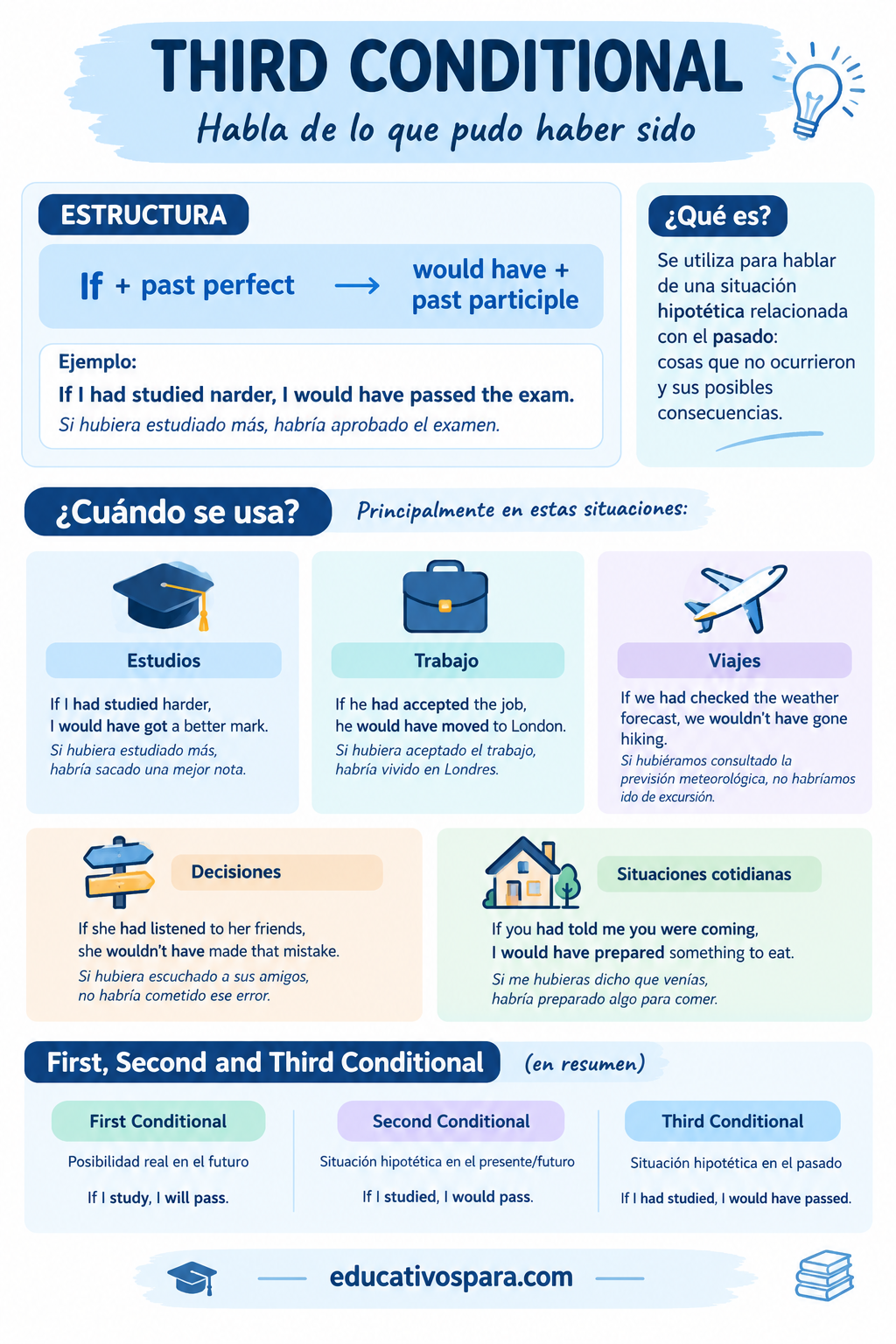
Estos son algunos ejemplos que permiten identificar fácilmente la estructura:
If I had known about the party, I would have gone.
Si hubiera sabido lo de la fiesta, habría ido.
If she had studied medicine, she would have become a doctor.
Si hubiera estudiado Medicina, se habría convertido en médica.
If we had booked earlier, we would have paid less.
Si hubiéramos reservado antes, habríamos pagado menos.
If he had taken an umbrella, he wouldn’t have got wet.
Si hubiera cogido un paraguas, no se habría mojado.
If they had invited me, I would have attended the meeting.
Si me hubieran invitado, habría asistido a la reunión.
En todos estos ejemplos existe una característica común: la condición no se produjo realmente y la consecuencia tampoco ocurrió como se plantea en la oración.
¿Se puede cambiar el orden de la oración?
Sí. La oración puede comenzar por la condición o por la consecuencia.
Por ejemplo:
If I had known, I would have helped you.
También podemos decir:
I would have helped you if I had known.
El significado es el mismo.
Cuando la oración comienza con if, normalmente utilizamos una coma para separar las dos partes:
If I had known, I would have helped you.
Cuando la condición aparece al final, no necesitamos utilizar coma:
I would have helped you if I had known.
¿Podemos utilizar otras formas además de would?
Sí. Aunque would have es la estructura más habitual, también podemos utilizar otros verbos modales para expresar diferentes matices.
Could have
Utilizamos could have + participio para expresar una posibilidad o capacidad que existía en el pasado.
If I had had more time, I could have finished the project.
Si hubiera tenido más tiempo, podría haber terminado el proyecto.
Might have
Utilizamos might have + participio para expresar una posibilidad menos segura.
If she had taken the earlier train, she might have arrived on time.
Si hubiera cogido el tren anterior, quizá habría llegado a tiempo.
Por tanto, podemos encontrar estructuras como:
If + past perfect + could have + participle
o
If + past perfect + might have + participle
La importancia de “had” en el third conditional
Uno de los errores más frecuentes al aprender el tercer condicional consiste en confundir el past perfect con otros tiempos verbales.
La condición debe construirse con:
had + past participle
Por ejemplo:
If I had studied…
If she had gone…
If they had known…
No debemos utilizar simplemente el pasado:
❌ If I studied more, I would have passed.
La estructura correcta para un third conditional es:
✅ If I had studied more, I would have passed.
También debemos recordar que had funciona como auxiliar del past perfect, por lo que aparece independientemente de la persona:
- I had studied
- you had studied
- he had studied
- she had studied
- we had studied
- they had studied


El verbo “to have” en el third conditional
Una cuestión que puede resultar especialmente confusa es cuando el verbo principal es have.
Por ejemplo:
If I had had more money, I would have bought the car.
Aunque pueda parecer extraño encontrar dos had seguidos, la estructura es correcta.
El primer had funciona como auxiliar del past perfect y el segundo corresponde al participio del verbo have:
had + had
Otro ejemplo:
If we had had more time, we would have stayed longer.
Si hubiéramos tenido más tiempo, nos habríamos quedado más tiempo.
Diferencia entre first conditional y third conditional
Aunque ambos son condicionales, expresan situaciones diferentes.
El first conditional se utiliza principalmente para hablar de situaciones posibles o probables relacionadas con el presente o el futuro.
Su estructura básica es:
If + present simple, will + infinitive
If I study, I will pass the exam.
Si estudio, aprobaré el examen.
En cambio, el third conditional habla de una situación hipotética que pertenece al pasado y que ya no puede cambiarse:
If + past perfect, would have + past participle
If I had studied, I would have passed the exam.
Si hubiera estudiado, habría aprobado el examen.
La diferencia fundamental puede resumirse así:
First conditional → posibilidad futura
Third conditional → situación hipotética del pasado
Ejercicios del Third conditional en inglés
Exercise 1
Choose the correct option:

Exercise 2
Choose the correct option: