¿Te cuesta distinguir entre Defining Relative Clauses y Non-Defining Relative Clauses? ¿No tienes claro cuándo utilizar who, which, that, whose, where o when?
Las relative clauses son estructuras muy habituales en inglés y, aunque al principio pueden parecer complicadas, hay una idea clave que nos ayuda a entenderlas:
- Defining Relative Clauses → la información es necesaria.
- Non – defining Relative Clauses → la información es adicional.
Vamos a verlo paso a paso, con ejemplos sencillos, trucos para recordarlo y ejercicios interactivos para comprobar si realmente lo has entendido.
1. ¿Qué son Relative Clauses?
Una relative clause es una oración que nos proporciona información sobre una persona, animal, cosa, lugar o momento que hemos mencionado anteriormente. Por ejemplo:
- The girl who lives next door is my best friend. → La chica que vive al lado es mi mejor amiga.
La parte who lives next door nos proporciona información sobre the girl. De esta forma evitamos decir: The girl is my best friend. The girl lives next door.
También podemos decir:
- I bought a new phone which has an excellent camera → Me compré un teléfono que tiene una cámara excelente
En ambos casos, la relative clause nos permite unir información en una misma oración y evitar repetir palabras. De esta forma evitamos decir: Me compré un teléfono. Mi teléfono tiene una cámara excelente.
2. Relative Pronouns: los pronombres relativos
Para formar una relative clause utilizamos normalmente un relative pronoun o pronombre relativo. Los más habituales son:
| Relative pronoun | Se utiliza principalmente para… | Example |
|---|---|---|
| who | personas | The woman who called me… |
| whom | personas como objeto, especialmente en lenguaje formal | The woman whom I met… |
| which | cosas y animales | The book which I bought… |
| that | personas, cosas y animales en defining clauses | The car that I bought… |
| whose | posesión | The girl whose brother is a doctor… |
| where | lugares | The house where I grew up… |
| when | momentos o períodos de tiempo | The day when we met… |
2.1.Who
Utilizamos who principalmente para hablar de personas.
The woman who works here is very friendly.
La mujer que trabaja aquí es muy amable.
The student who won the competition is from Madrid.
El alumno que ganó el concurso es de Madrid.
2.2.Whom
Whom se utiliza para hablar de personas cuando funcionan como objeto de la relative clause. Es más frecuente en un registro formal. En inglés cotidiano, normalmente utilizamos who o incluso omitimos el pronombre cuando es posible.
Compara:
The woman whom I met yesterday was very friendly.
The woman who I met yesterday was very friendly.
The woman I met yesterday was very friendly.
Las tres estructuras son correctas, pero whom es la opción más formal.
Who or Whom?
La diferencia puede resultar más sencilla si pensamos en subject y object:
Who → normalmente sujeto
Whom → objeto
Por ejemplo:
The man who called me is my teacher.
Aquí who es el sujeto de called:
Who called me? → The man.
Pero:
The man whom I called is my teacher.
Aquí I es el sujeto y whom es el objeto:
Whom did I call? → The man.
💡 Truco: si puedes sustituirlo por he/she, normalmente utilizamos who. Si puedes sustituirlo por him/her, whom es posible.
Who called you? → He called me.
Whom did you call? → I called him.
En el inglés actual, especialmente en situaciones informales, who es mucho más habitual que whom.
2.3.Whose: hablar de posesión
Whose no significa simplemente “que”, sino que indica que algo pertenece a alguien o está relacionado con alguien.
The girl whose father is a doctor is my friend.
La chica cuyo padre es médico es mi amiga.
La estructura es:
whose + noun
Por ejemplo:
The student whose laptop was stolen reported it to the teacher.
The company whose products are popular has opened a new shop.
Y recuerda que whose también puede utilizarse para cosas, no solamente para personas:
The house whose roof was damaged needs repairing.
2.4.Which
Utilizamos which para cosas y animales.
The book which I bought yesterday is excellent.
El libro que compré ayer es excelente.
The dog which lives next door is very noisy.
El perro que vive al lado hace mucho ruido.
2.5.That
That puede utilizarse en muchas defining relative clauses para referirnos tanto a personas como a cosas o animales.
The man that lives next door is a doctor.
The computer that I bought is very fast.
Sin embargo, hay una regla importante que debemos recordar:
⚠️ That NO se utiliza en non-defining relative clauses.
Por ejemplo:
❌ My brother, that lives in London, is a teacher.
✅ My brother, who lives in London, is a teacher.
2.6.Whose
Whose indica posesión y equivale aproximadamente a cuyo/a, cuyos/as.
The girl whose father is a doctor is my friend.
La chica cuyo padre es médico es mi amiga.
I met a man whose car was stolen.
Conocí a un hombre al que le habían robado el coche.
Where
Utilizamos where para hablar de lugares.
This is the restaurant where we had dinner.
Este es el restaurante donde cenamos.
When
Utilizamos when para referirnos a momentos o períodos de tiempo.
I remember the day when we first met.
Recuerdo el día en que nos conocimos.
3. Defining Relative Clauses
Las Defining Relative Clauses nos proporcionan información necesaria para identificar exactamente a la persona o cosa de la que estamos hablando. Por eso, también podemos pensar en ellas como información esencial. Mira este ejemplo:
- The boy who is wearing a blue jacket is my brother → El chico quien lleva puesta una chaqueta azul es mi hermano.
¿Qué chico? No sabemos exactamente cuál es hasta que añadimos “who is wearing a blue jacket”.
La información es necesaria para identificarlo.
Defining Relative Clauses no llevan comas
Esta es una de las reglas más importantes. Por ejemplo:
- The students who studied passed the exam → Los estudiantes que estudiaron aprobaron el examen.
Aquí estamos hablando de los estudiantes que estudiaron. La información “who studied” nos ayuda a identificar de qué estudiantes estamos hablando. Veamos otro ejemplo:
- The car that is parked outside is mine → El coche que está aparcado afuera es mío.
¿Qué coche es mío? El que está aparcado fuera. Si eliminamos la relative clause quedaría “the car is mine”. La información ha cambiado y ya no sabemos qué coche estamos identificando.
¿Podemos omitir la “relative clause”?
En algunas defining relative clauses, sí podemos omitir el pronombre relativo. Esto ocurre cuando el pronombre funciona como objeto de la oración. Veamos algunos ejemplos para comparar:
| Con “relative clause” | Sin “relative clause” | Explicación |
| The book that I bought was expensive | The book I bought was expensive | Ambas frases son correctas. Podemos eliminar “that” porque “bought” ya tiene sujeto (“I”) y el objeto está implícito. |
| The woman who I met yesterday was very friendly. | The woman I met yesterday was very friendly. | Aparece un sujeto junto a “met” y el objeto “the woman” está implícito. Por eso se puede eliminar “who”. |
| The woman who lives next door is a doctor | ❌ The woman lives next door is a doctor. | Aquí no podemos eliminar “who” porque no hay ningún sujeto que acompañe a “lives”. |
Por tanto:
💡 If the relative pronoun is the subject → don’t omit it.
If it is the object → it can often be omitted.
4. Non-Defining Relative Clauses
Y ahora llegamos a la segunda gran categoría. Las Non-Defining Relative Clauses proporcionan información adicional sobre alguien o algo que ya está identificado. Por ejemplo:
- My brother, who lives in London, is a doctor. → Mi hermano, quién vive en Londres, es doctor.
Sabemos quién es “my brother“. La información “who lives in London” simplemente añade un dato. Por eso recibe el nombre de non-defining: la información no es necesaria para identificar a la persona y puede omitirse.
Las comas son fundamentales
En las Non-Defining Relative Clauses, la información aparece entre comas. Por ejemplo:
- My sister, who lives in Madrid, is a teacher. → Mi hermana, quién vive en Madrid, es profesora.
Las comas nos indican que “who lives in Madrid” es información adicional. Si eliminamos la relative clause: My sister is a teacher; la frase sigue teniendo sentido y sabemos de quién estamos hablando.
5. Defining vs Non-Defining: ¿por qué son importantes las comas?
Las comas no son simplemente una cuestión de puntuación. Pueden cambiar el significado de la oración.
Compara:
The students who passed the exam received a certificate.
Aquí hablamos únicamente de los estudiantes que aprobaron el examen.
Pero:
The students, who passed the exam, received a certificate.
Aquí estamos diciendo que todos los estudiantes aprobaron el examen y añadimos esa información como un dato adicional.
6. Defining vs Non-Defining: la diferencia en un vistazo
| Defining | Non-Defining | |
|---|---|---|
| Información | Necesaria | Adicional |
| Comas | ❌ No | ✅ Sí |
| That | ✅ Sí | ❌ No |
| Pronombre relativo | A veces se puede omitir | ❌ No |
| Ejemplo | The girl who called me… | Sarah, who called me,… |
7. Errores frecuentes
7.1.Which, Who or That?
Esta es una de las dudas más frecuentes al trabajar con relative pronouns.
Para personas utilizamos normalmente “who” y para cosas “which”, pero en las defining relative clauses podemos sustituirlo por “that”.
Ejemplos:
- The teacher who helped me was very kind → The teacher that helped me was very kind.
- The book which I bought is interesting → The book that I bought is interesting
Pero cuidado con Non-Defining
En una non-defining relative clause utilizamos who o which, pero no that.
✅ My car, which is very old, still works.
❌ My car, that is very old, still works.
✅ My brother, who lives in London, is a doctor.
❌ My brother, that lives in London, is a doctor.
7.2. Usar “that” después de una coma
❌ My sister, that lives in London, is a doctor.
✅ My sister, who lives in London, is a doctor.
Porque that no se utiliza en non-defining relative clauses.
7.3.Usar “which” para personas
❌ The woman which works here is very nice.
✅ The woman who works here is very nice.
Porque estamos hablando de una persona.
7.4. Olvidar las comas
❌ My father who is a doctor lives in Madrid.
Si who is a doctor es simplemente información adicional sobre un padre que ya está identificado, necesitamos las comas:
✅ My father, who is a doctor, lives in Madrid.
7.5. Repetir el objeto
❌ The girl who I met her yesterday was very friendly.
✅ The girl who I met yesterday was very friendly.
No necesitamos her porque who ya ocupa la posición del objeto.
8. Prepositions + Relative Clauses
Este es un punto especialmente importante porque las preposiciones también pueden aparecer dentro de las relative clauses. Por ejemplo: This is the house which I live in.
La preposición in aparece al final de la oración. Sin embargo, en un registro más formal podemos colocar la preposición antes del relative pronoun: This is the house in which I live.
Las dos estructuras son correctas y tienen prácticamente el mismo significado.
Preposition at the end vs. preposition + relative pronoun
| More common / informal | More formal |
|---|---|
| The house which I live in. | The house in which I live. |
| The person who I spoke to. | The person to whom I spoke. |
| The company which she works for. | The company for which she works. |
| The topic which we talked about. | The topic about which we talked. |
Por tanto, podemos encontrar esta estructura:
preposition + which/whom
With which
Utilizamos which después de una preposición cuando hablamos de cosas. Por ejemplo:
- This is the house in which I grew up. → Esta es la casa en la cuál yo crecí.
- The project on which we are working is very interesting → El proyecto en el cuál nosotros estamos trabajando es muy interesante.
- That is the topic about which we were talking → Este es el tema sobre el cuál nosotros estábamos hablando.
With whom
Cuando hablamos de personas, podemos utilizar whom después de una preposición. Por ejemplo:
- The woman to whom I spoke was very helpful → La mujer con la que hablé fue muy servicial.
- The teacher with whom I worked was excellent → La profesora con la que trabajé fue excelente
- The student for whom I bought the book was absent → El estudiante para quién yo compré el libre estaba ausente.
Esta estructura es especialmente habitual en formal English.
What about “at which”?
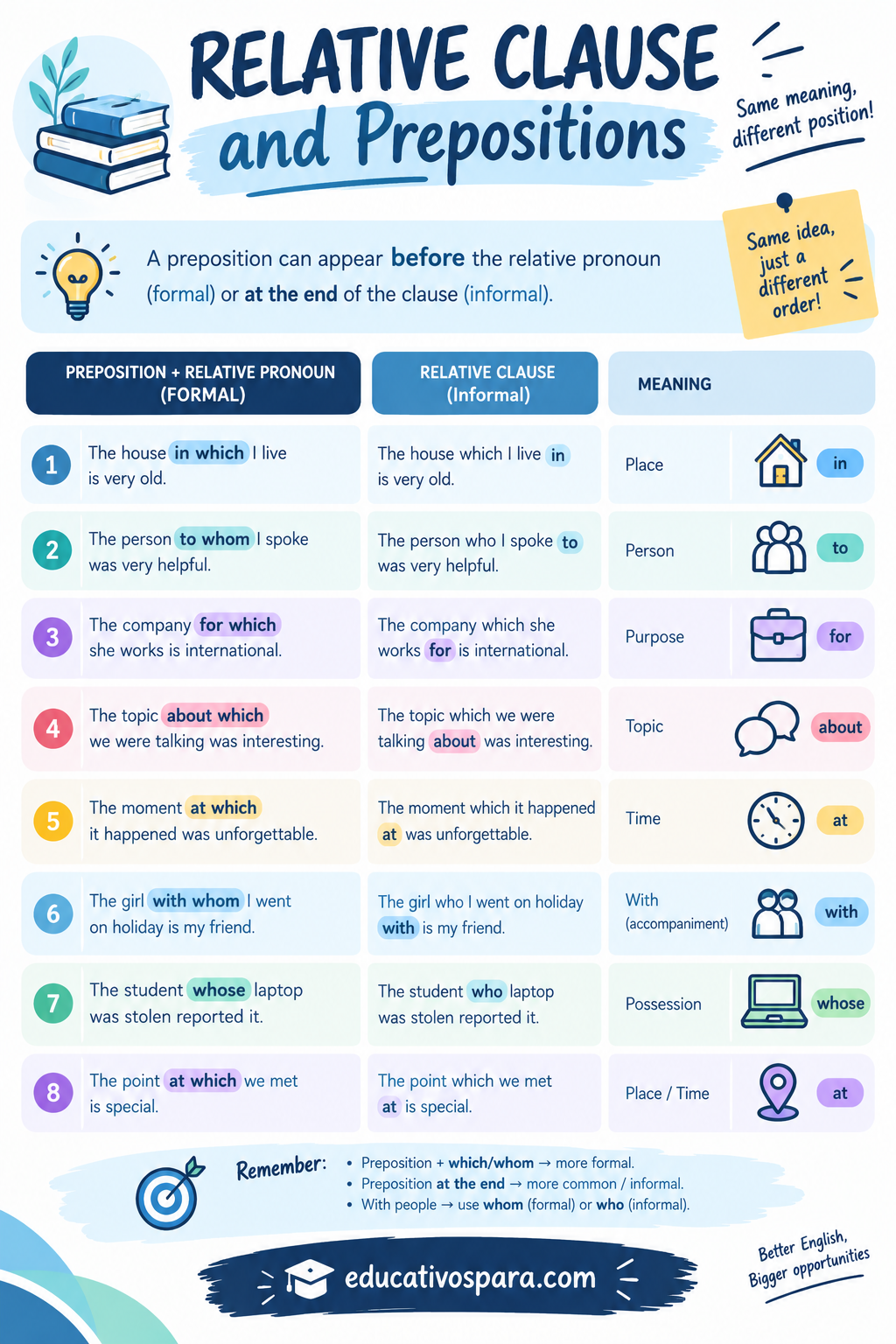
También podemos encontrar at which, especialmente cuando el verbo o la expresión necesita la preposición at. Por ejemplo:
- This is the point at which the story changes → Este es el punto en el cuál la historia cambia
- That was the moment at which I realised my mistake → Ese fue el momento en el cuál yo cometí mi error.
- The speed at which the machine operates is very high → La velocidad en la cuál la máquina trabaja es muy alta
Sin embargo, en muchos contextos existen alternativas más naturales en el inglés cotidiano:
- This is the point where the story changes. → Este es el punto donde la historia cambia
- That was the moment when I realised my mistake → Ese fue el momento cuando yo cometí mi error.
Por eso, no debemos pensar que at which es una estructura obligatoria. Es una construcción más formal que aparece cuando at forma parte de la relación que queremos expresar.
💡 Remember:
Preposition + which → things
the house in which I live
Preposition + whom → people
the person to whom I spoke
Y en inglés menos formal, la preposición suele desplazarse al final:
the house which I live in
the person who I spoke to
A useful exam tip
Cuando encuentres una estructura como:
the person ___ I spoke to
puedes utilizar:
who → The person who I spoke to…
o, en un registro más formal:
whom → The person whom I spoke to…
o:
to whom → The person to whom I spoke…
Las tres son posibles, pero presentan diferentes grados de formalidad.