Topic 4. The value of foreign language knowledge as a means of communication between people and peoples. Interest in linguistic diversity through the knowledge of a new language and its culture.
- Introduction
- Foreign languages as a means of communication
2.1. Language and communication
2.2. English as a means of international communication
2.3. From learning a language to using a language - The value of foreign language learning
3.1. Personal and educational benefits
3.2. Social and cultural benefits
3.3. Foreign languages and global citizenship - Linguistic diversity and plurilingualism
4.1. Linguistic diversity as a source of enrichment
4.2. The plurilingual approach
4.3. Comparing languages and developing linguistic awareness - Language and culture
5.1. The relationship between language and culture
5.2. Intercultural competence
5.3. Avoiding stereotypes and developing respect - Didactic application in Primary Education
6.1. Bringing linguistic and cultural diversity into the classroom
6.2. Communicative and intercultural activities
6.3. Real communication with other speakers
6.4. Attention to diversity and inclusive practice - Conclusion
- Bibliographical references and legislation
1. Introduction
“He who knows no foreign languages knows nothing of his own.”
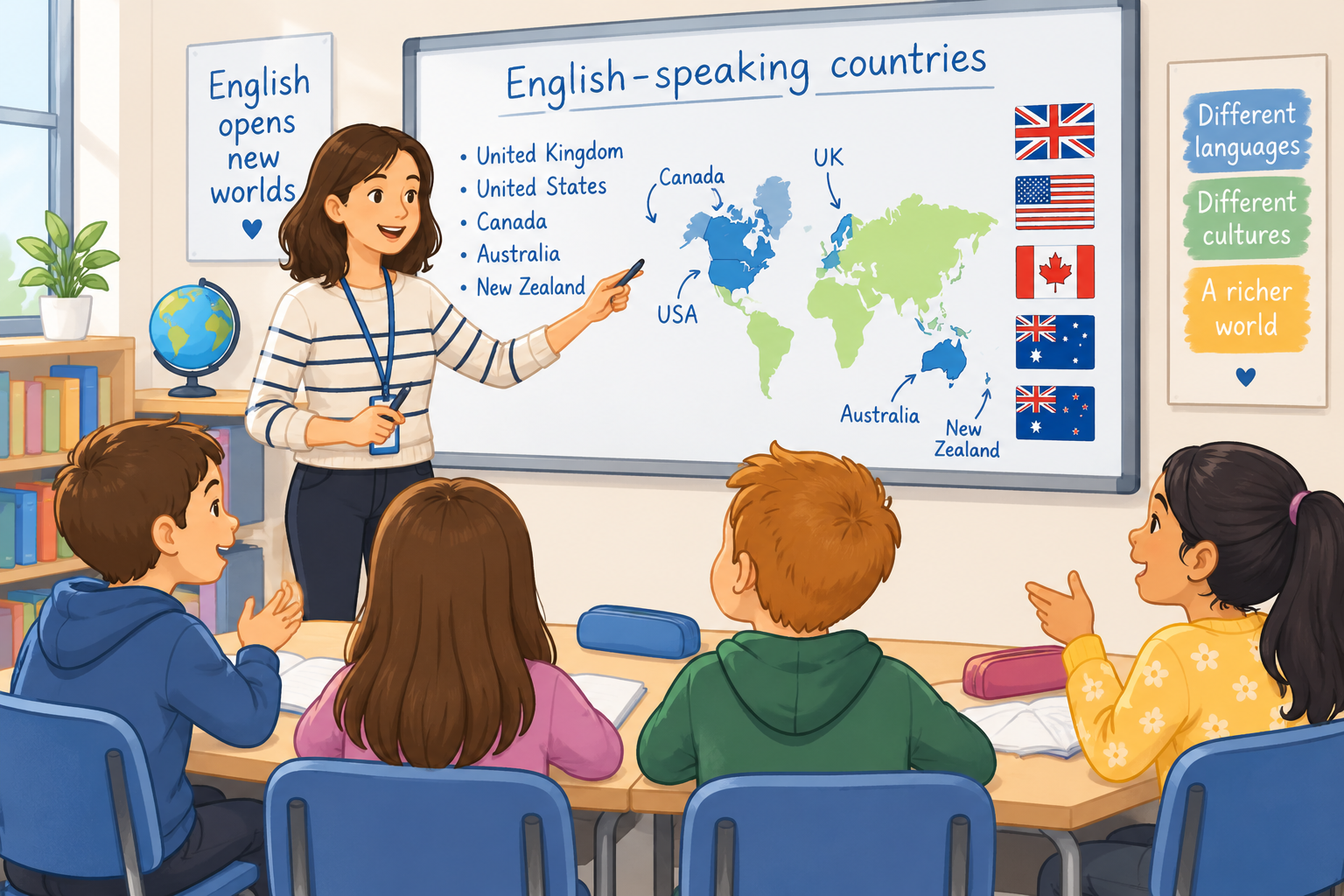
This well-known statement attributed to Johann Wolfgang von Goethe highlights an important idea: learning another language does not simply mean adding a new linguistic system to our knowledge. It also allows us to discover other ways of communicating and understanding the world, while at the same time becoming more aware of our own language and culture.
In today’s interconnected societies, knowing a foreign language is increasingly valuable. Languages allow people from different countries and cultural backgrounds to communicate, cooperate, study, travel and establish personal and professional relationships.
However, foreign language learning at school should not be reduced to acquiring vocabulary and grammatical structures. Learning English also means discovering that people may express themselves differently, follow different social conventions and have different cultural references. This makes language learning an opportunity to develop curiosity, empathy, respect and openness towards others.
This perspective is reflected in the current curriculum. Royal Decree 157/2022 describes the Foreign Language area as contributing directly to plurilingual competence and emphasises both its communicative and intercultural dimensions. It establishes that learning a foreign language should help pupils discover other cultures, respect linguistic diversity and develop intercultural communicative competence.
In the Comunidad de Madrid, Decreto 61/2022 also gives a specific place to the blocks of Plurilingüismo and Interculturalidad. The curriculum highlights the foreign language as a means of communication and relationship with people from other countries, as well as a way of discovering other cultures and ways of life.
Therefore, this topic will analyse the value of foreign language knowledge as a means of communication, the importance of linguistic diversity and the relationship between language and culture, paying particular attention to their practical application in the Primary English classroom.
2. Foreign languages as a means of communication
2.1. Language and communication
The fundamental purpose of language is communication. Through language, people exchange information, express emotions and opinions, establish relationships and participate in social life.
Learning a foreign language therefore provides pupils with an additional means of communicating with people who do not share their first language.
This idea has important implications for language teaching. If English is presented only as a school subject, pupils may associate it with exercises, vocabulary lists and grammatical rules. If, instead, it is presented as a tool for communicating with real people, its purpose becomes much more meaningful.
For example, knowing how to ask “Where are you from?” is not especially valuable because pupils can reproduce the structure. It becomes valuable when they can use it to discover something about a real person.
Communication is consequently both the objective and the means of foreign language learning.
2.2. English as a means of international communication
English occupies a particularly important position in international communication. It is used by people with different first languages in areas such as tourism, education, science, technology, culture and international cooperation.
This does not mean that English should replace other languages. On the contrary, its role as a lingua franca can provide pupils with opportunities to communicate beyond their immediate linguistic environment while reinforcing the importance of maintaining linguistic diversity.
In the Primary classroom, this can be introduced through realistic situations. Pupils may imagine that they are travelling to another country, communicate with another class, create a tourist guide for foreign visitors or exchange information with children from another part of the world.
The important point is that English acquires a genuine communicative purpose.
2.3. From learning a language to using a language
A communicative approach changes the way in which foreign language learning is understood.
Pupils should not only know linguistic forms but also learn how to use them appropriately. This includes knowing how to greet someone, ask for information, express an opinion, show agreement, apologise, ask for clarification or adapt a message to the situation.
Canale and Swain (1980) and Canale (1983) contributed significantly to the development of the concept of communicative competence, highlighting that effective communication involves grammatical, sociolinguistic, discourse and strategic dimensions.
Consequently, knowing English means progressively acquiring the ability to use it in meaningful situations.
A Primary classroom should therefore provide opportunities for pupils to communicate, not simply to demonstrate that they have memorised linguistic content.
3. The value of foreign language learning
3.1. Personal and educational benefits
Learning a foreign language can contribute to pupils’ personal and cognitive development.
It allows learners to:
- Communicate with a wider range of people.
- Access information from different sources.
- Develop curiosity and motivation.
- Reflect on how languages work.
- Compare linguistic structures.
- Develop strategies for solving communication problems.
- Become more confident in unfamiliar situations.
- Increase their awareness of other perspectives.
Learning another language also encourages learners to reflect on their own language. When pupils notice that English expresses certain ideas differently from Spanish, they become more aware that languages organise and represent reality in different ways.
For example, comparing expressions of politeness, ways of forming questions or ways of addressing other people can help pupils understand that linguistic choices are connected with social conventions.
3.2. Social and cultural benefits
Foreign language knowledge can also contribute to social development.
Communication with people from different linguistic and cultural backgrounds requires listening, flexibility and respect. Pupils learn that differences do not necessarily represent obstacles but can become opportunities for learning.
In this sense, language education contributes to values such as cooperation, empathy and respect for diversity.
The curriculum explicitly connects the Foreign Language area with these objectives. The intercultural dimension seeks to help pupils appreciate linguistic, cultural and artistic diversity and learn to manage intercultural situations while rejecting discrimination, prejudice and stereotypes.


3.3. Foreign languages and global citizenship
Foreign language learning can also contribute to the development of global citizenship.
Today’s pupils may interact with people from different countries through education, travel, digital communication and future professional contexts. They therefore need not only linguistic resources but also the ability to communicate respectfully with people whose experiences may be different from their own.
The English classroom can contribute to this development through topics such as environmental protection, children’s rights, cultural diversity or sustainable lifestyles.
For instance, pupils from different countries may have different ways of celebrating a particular event or dealing with environmental issues. Comparing these perspectives can lead to discussion without presenting one culture as the norm.
The aim is not to make pupils abandon their own cultural identity, but to help them develop a broader and more flexible perspective.
4. Linguistic diversity and plurilingualism
4.1. Linguistic diversity as a source of enrichment
The world contains a great variety of languages and linguistic varieties. This diversity reflects the history, identity and experiences of different communities.
In school, linguistic diversity may already be present in the classroom itself. Pupils may speak Spanish, English or other languages within their families or communities.
This reality should be considered an educational resource rather than a problem.
For example, a teacher can create a classroom language map in which pupils identify the languages they know or hear in their families and communities. Pupils can compare greetings, numbers, words for colours or expressions of politeness.
The objective is not for pupils to learn all these languages. Rather, they should become aware that there are different ways of communicating and that all languages have value for their speakers.
The Spanish curriculum explicitly recognises linguistic diversity as a source of cultural richness and encourages reflection on the languages present in pupils’ repertoires.
4.2. The plurilingual approach
Plurilingualism goes beyond simply knowing several languages separately.
The plurilingual approach considers a person’s languages as part of an interconnected repertoire. Knowledge and strategies acquired in one language can support the learning of another.
For example, a pupil who already understands how plural forms work in Spanish may notice similarities or differences when learning English. Likewise, strategies for guessing the meaning of an unknown word from context can be transferred between languages.
This approach therefore encourages pupils to use their previous linguistic knowledge as a resource.
The curriculum explicitly states that pupils’ experiences with the languages they know can serve as a basis for learning new languages and developing a richer plurilingual repertoire.
In practical terms, the English teacher can encourage comparison without turning the lesson into a translation exercise. Pupils can identify cognates, compare word formation, observe similarities between expressions or discuss differences in pronunciation and spelling.
4.3. Comparing languages and developing linguistic awareness
Comparison between languages can develop linguistic awareness.
For example, pupils may notice that:
- Some English words resemble words in Spanish.
- English and Spanish organise certain sentences differently.
- Some sounds exist in one language but not in another.
- Expressions of politeness may differ.
- The same idea may require different grammatical structures.
Such observations can make pupils more conscious of the language they are learning.
They can also help develop learning strategies. If pupils discover that the prefix “un-” can indicate opposition in words such as “unhappy” or “unusual”, they may use this knowledge to interpret unfamiliar vocabulary.
Thus, linguistic comparison is not an end in itself. It becomes a tool for improving communication and learning.
5. Language and culture
5.1. The relationship between language and culture
Language and culture are closely connected.
Languages reflect aspects of the communities that use them: social relationships, traditions, values, conventions, ways of expressing politeness and references to everyday life.
Therefore, learning English without any cultural dimension would provide pupils with only a partial understanding of the language.
For example, pupils can learn expressions such as “How are you?” without necessarily understanding that its communicative function may be different from a literal request for detailed information about someone’s health.
Similarly, conventions surrounding greetings, politeness, personal space or forms of address may vary between cultures.
The teacher should therefore introduce cultural elements in context rather than presenting them as isolated facts.
5.2. Intercultural competence
Intercultural competence involves being able to interact appropriately and respectfully with people from different cultural backgrounds.
It includes several dimensions:
- Knowledge of aspects of other cultures.
- Awareness of one’s own cultural perspective.
- Curiosity towards other ways of life.
- Ability to compare perspectives.
- Empathy and openness.
- Ability to avoid generalisations.
- Respectful behaviour in intercultural situations.
The objective is not for pupils to memorise lists of traditions or stereotypical information about English-speaking countries.
Instead, they should learn to ask questions, compare realities and understand that cultures are diverse and constantly changing.
For example, rather than teaching that “British people always…” or “Americans usually…”, the teacher can present different examples and encourage pupils to identify similarities and differences without making absolute generalisations.
5.3. Avoiding stereotypes and developing respect
One of the responsibilities of the English teacher is to prevent the reproduction of stereotypes.
Cultural teaching should therefore avoid presenting countries as homogeneous entities. English is spoken in many different contexts, and English-speaking societies contain considerable cultural, social and linguistic diversity.
The classroom can challenge stereotypes through authentic or adapted materials representing different speakers, families, lifestyles and communities.
Pupils can compare several perspectives and discuss questions such as:
“Is this tradition common to everyone?”
“Do all people in this country live in the same way?”
“Can we find similarities with our own culture?”
This approach develops critical thinking while encouraging respect.
It is also consistent with the curriculum’s emphasis on rejecting prejudice and discrimination and appreciating diversity as a source of personal enrichment.
6. Didactic application in Primary Education
6.1. Bringing linguistic and cultural diversity into the classroom
The ideas developed above should become visible in everyday classroom practice.
The first step is to recognise the linguistic and cultural resources that pupils already possess.
A simple activity is to create a “language wall” containing greetings in the different languages represented in the classroom. Pupils can then identify similarities and differences and use English to explain what they have discovered.
Another possibility is a “language passport” in which pupils record the languages they know, the situations in which they use them and the skills they have developed.
These activities help pupils understand that learning languages is not an isolated school task but part of their personal linguistic biography.
6.2. Communicative and intercultural activities
Many classroom activities can combine communication and intercultural learning.
For example:
- Comparing school routines in different countries.
- Creating a multilingual classroom dictionary.
- Exploring children’s games from different cultures.
- Comparing typical breakfasts.
- Reading stories from different cultural backgrounds.
- Investigating how children celebrate special occasions.
- Preparing a virtual or written exchange with another class.
- Creating a multicultural class magazine.
- Comparing expressions of politeness.
- Designing a tourist guide for visitors.
The important point is that cultural content should generate communication.
For example, pupils should not simply complete a worksheet about British food. They can instead work in groups to design a menu for an international school event, discuss their choices and present the final proposal in English.
In this way, cultural learning becomes active and communicative.
6.3. Real communication with other speakers
Whenever possible, contact with real speakers or learners of English can give the language an authentic purpose.
The current curriculum explicitly values communication with speakers or learners of the foreign language through different media, including letters, emails, video calls and collaborative presentations.
A Primary class could therefore participate in an international exchange in which pupils introduce themselves, describe their school, ask questions about everyday life and share a collaborative product.
The experience does not need to depend exclusively on technology. Letters, postcards, audio recordings or shared classroom projects can also create meaningful communication.
If digital resources are used, they should serve the communicative objective and be integrated responsibly into the learning process.
6.4. Attention to diversity and inclusive practice
The intercultural approach should also include the diversity present within the classroom itself.
Pupils may have different linguistic repertoires, cultural experiences, levels of English and opportunities to encounter other languages outside school.
The teacher should therefore avoid assuming that all pupils share the same cultural background.
Activities can provide different ways of participating: oral contributions, drawings, written texts, visual presentations, cooperative tasks or short recordings.
Scaffolding may include vocabulary banks, sentence starters, visual organisers, models and examples.
In this way, all pupils can contribute their experiences while developing English.
The teacher should also establish clear rules for respectful communication. Differences in pronunciation, accent, family traditions or linguistic background should never become a reason for ridicule.
The classroom can become precisely the environment in which pupils learn that linguistic diversity is normal and valuable.
7. Conclusion
Learning a foreign language is much more than acquiring a new code. It gives learners the possibility of communicating with more people, accessing new information and discovering perspectives that may differ from their own.
English, because of its international use, can become a particularly valuable tool for communication. However, its educational value does not lie in replacing other languages or cultures. On the contrary, learning English should contribute to developing a broader appreciation of linguistic diversity and to strengthening pupils’ own linguistic identity.
The plurilingual and intercultural approaches provide an appropriate framework for this purpose. By comparing languages, pupils become more aware of how languages function; by discovering other cultures, they learn to question stereotypes; and through real communication, they understand that language is ultimately a tool for building relationships.
Therefore, the English classroom should be a place where pupils do not simply learn about other countries, but where they learn to communicate with people, listen to different perspectives and approach diversity with curiosity and respect.
Ultimately, the value of a foreign language lies not only in what pupils can say in that language, but also in the people they can communicate with and the perspectives they can discover through it.
8. Bibliographical references and legislation
- Byram, M. (1997). Teaching and Assessing Intercultural Communicative Competence. Multilingual Matters.
- Canale, M. & Swain, M. (1980). Theoretical Bases of Communicative Approaches to Second Language Teaching and Testing. Applied Linguistics, 1(1), 1–47.
- Council of Europe (2020). Common European Framework of Reference for Languages: Learning, Teaching, Assessment – Companion Volume. Council of Europe Publishing.
- Crystal, D. (2003). English as a Global Language. Cambridge University Press.
- Hymes, D. (1972). On Communicative Competence. In J. B. Pride & J. Holmes (eds.), Sociolinguistics. Penguin.
- Kramsch, C. (1993). Context and Culture in Language Teaching. Oxford University Press.
Legislation:
- Ley Orgánica 2/2006, de 3 de mayo, de Educación, as amended by Ley Orgánica 3/2020, de 29 de diciembre.
- Real Decreto 157/2022, de 1 de marzo, por el que se establecen la ordenación y las enseñanzas mínimas de la Educación Primaria.